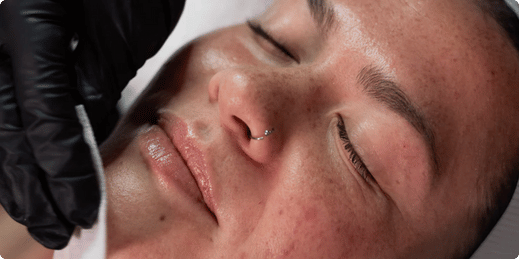
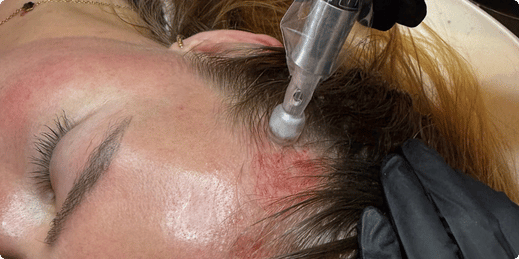

6 month professional depigmentation programme
Cosmelan is not a one-off chemical peel. It is a six-month professional depigmentation programme designed to reduce existing pigmentation while helping regulate the ongoing overproduction of melanin.
The programme begins with an in-clinic Cosmelan 1 treatment, where the professional depigmenting mask is applied and left on the skin for a prescribed number of hours before being removed at home.
From there, you begin the Cosmelan 2 homecare phase. This is a structured treatment protocol used consistently over the following months to continue reducing pigmentation and help control the biological processes responsible for its formation.
Throughout the six months, your skin is professionally monitored in clinic, with your homecare frequency and supporting products adjusted according to your skin’s response.
The goal isn’t simply to fade what you can see today, it’s to achieve progressive pigment correction while helping reduce its tendency to reappear.
What’s Included in Your Cosmelan Treatment

Professional Cosmelan depigmentation treatment performed in clinic.

3 full size homecare products- Cosmelan 2, Melan 130 Pigment Control SPF50+ and Melan Recovery included.

Six LED Light Therapy treatments throughout your 6-month programme to support skin recovery and barrier function.

Ongoing guidance, skin monitoring and support throughout your Cosmelan programme.
Melasma
Melasma is a chronic pigmentary condition that typically appears as symmetrical patches of brown or grey-brown pigmentation, commonly across the cheeks, forehead, upper lip and jawline. It is influenced by multiple factors including hormones, UV exposure, visible light, heat and genetic predisposition
Sun Spots / Solar Lentigo
Solar lentigo, commonly called sun or age spots, are well-defined areas of pigmentation caused by cumulative UV exposure over time. They most commonly develop on areas regularly exposed to the sun, including the face, décolletage and hands. .
Post-Inflammatory Hyperpigmentation
Post-inflammatory hyperpigmentation (PIH) develops after inflammation or injury stimulates excess melanin production. It can follow acne, dermatitis, picking, burns or other forms of skin trauma and appears as brown to grey-brown marks where the inflammation previously occurred.
Uneven / Diffuse Hyperpigmentation
Not all pigmentation forms distinct spots or patches. Diffuse hyperpigmentation can present as an overall uneven skin tone, areas of mottled pigmentation or generalised darkening caused by a combination of UV exposure, inflammation, hormonal influences and cumulative melanocyte activity
Excess Melanin Production
Pigmentation develops when melanocytes produce excess melanin and transfer that pigment into surrounding skin cells.
This process can become overactive in response to UV exposure, hormones, inflammation and other biological triggers, contributing to concerns such as melasma, post-inflammatory hyperpigmentation and uneven skin tone.
Cosmelan is designed to intervene in this process rather than simply exfoliating pigment from the surface.
Melanogenesis Regulation
Melanin is produced through a biological process called melanogenesis, in which the enzyme tyrosinase plays a central role.
Cosmelan uses a combination of depigmenting actives that act at different points within this pathway, helping reduce excessive melanin synthesis and regulate abnormal pigment activity.
This is what separates a depigmentation programme from treatments that primarily remove superficial pigment.
Existing Pigment Correction
Regulating new pigment is only part of the process. Melanin that has already accumulated within the epidermis also needs to be progressively cleared.
The Cosmelan programme supports epidermal renewal and the gradual removal of melanin-containing keratinocytes, helping existing areas of pigmentation become less visible over time.
This creates a dual approach: reducing existing pigment while simultaneously helping control the formation of new pigment.
Professional Treatment + Home Regulation
The programme begins with the professional Cosmelan 1 mask, followed by a structured homecare protocol centred around Cosmelan 2.
The professional phase initiates intensive depigmentation, while continued home treatment helps maintain control over melanogenesis during the months that follow.
This ongoing regulation is a critical part of the Cosmelan method, stopping once pigmentation begins to fade can allow pigment activity to become visible again.
Pigmentation does not develop overnight, and effective management does not happen in a single treatment.
Over the six-month programme, the protocol changes as the skin progresses from intensive correction into regulation and maintenance.
This allows visible pigmentation to progressively improve while continuing to manage the melanocyte activity responsible for pigment formation.
The aim is not to permanently switch melanocytes off, melanin production is a normal and essential function of the skin. The goal is to better regulate excessive pigment activity and reduce its visible expression.
What sets Cosmelan apart?
Pigmentation isn’t simply something to “remove.” Melanin production is influenced by UV exposure, hormones, inflammation, heat and cellular signalling, which means treating pigment without understanding what is driving it can lead to poor results or in some cases, make pigmentation more noticeable.
Aggressive or inappropriate treatment can create inflammation, stimulate melanocyte activity and contribute to rebound pigmentation or post-inflammatory hyperpigmentation, particularly in pigment-prone skin.
That’s why we focus on controlling pigment production as well as correcting the pigment already visible within the skin. With Cosmelan, treatment continues well beyond the initial in-clinic application, using a structured six-month protocol designed to progressively reduce pigmentation while helping regulate ongoing melanin production.
Pigmentation needs control, not just correction.

Stages of the Cosmelan Peel
Week 1 the intensive phase
The in-clinic Cosmelan mask begins the process. Expect redness, dryness, sensitivity and peeling as your homecare programme begins.
Month 1 pigment starts to shift
Visible pigmentation begins to improve as Cosmelan 2 continues to regulate pigment production. Your skin is supported and monitored throughout.
Month 3 correct + control
By now, the focus moves beyond fading existing pigmentation to continuing pigment control and maintaining consistent results.
6 Months maintain your results
The focus shifts from correction to maintenance, helping preserve your results and keep pigmentation under control long-term.
Finally I've got a Melasma solution
Day 1 of my pigmentation/melasma journey at Lafont Advanced Skin Clinic
Already obsessed! The team made me feel so welcome, and their advice actually makes sense, no thumb‑sucking, just real knowledge. I’ve done my research, I’ve tried other clinics… and this one already feels different.
Cosmelan FAQs
What is Cosmelan and how does it treat pigmentation?
Cosmelan is a professional depigmentation programme designed to reduce existing pigmentation while helping regulate the processes involved in ongoing melanin production. Unlike treatments that only target pigment already visible at the surface, Cosmelan combines an in-clinic treatment with an extended homecare programme to progressively manage pigmentation and reduce its tendency to reappear.
What happens in a Cosmelan treatment
The Cosmelan mask is professionally applied in clinic and you leave with the mask still on your skin. You will be given a specific time to remove it at home based on your skin assessment. From there, a structured homecare protocol begins, including the continued use of Cosmelan 2.
Is Cosmelan a chemical peel?
Not in the traditional sense. Although peeling and shedding can occur, Cosmelan is better described as adepigmentation treatment programme. Its purpose isn't simply to exfoliate pigment from the skin, it also targets pathways involved in melanin production to provide ongoing pigment control.
Will my skin peel after Cosmelan?
Some peeling, flaking, dryness, redness, tightness and sensitivity are expected, particularly during the initial phase. The amount of visible peeling varies considerably between clients. More peeling does not mean better results. The objective is pigment regulation, not maximum exfoliation.
How long does it take to see results?
Changes can begin to become visible within the first few weeks, with pigmentation and overall skin tone continuing to improve over the following months. Cosmelan is a progressive programme rather than a one-day treatment, and consistency with the prescribed homecare is a major part of achieving and maintaining results.
Why do I need to use Cosmelan 2 at home?
Cosmelan 2 isn't simply an aftercare product, it is a fundamental part of the treatment. The in-clinic mask begins the depigmentation process, while Cosmelan 2 provides ongoing pigment-inhibiting activity throughout the programme. Stopping the homecare prematurely can compromise results and increase the likelihood of pigmentation returning.
Can Cosmelan permanently remove melasma?
No treatment can guarantee the permanent removal of melasma. Melasma is a chronic and highly reactive pigmentary condition influenced by factors including UV exposure, visible light, heat, hormones and inflammation. Cosmelan can significantly improve its appearance and help control melanogenesis, but ongoing pigment management and strict photoprotection remain important.
Can Cosmelan be used on darker skin tones?
Cosmelan can be suitable across a broad range of skin phototypes; however, darker skin tones also have a greater propensity for post-inflammatory pigment changes if the skin becomes excessively irritated. Treatment suitability, preparation and homecare therefore need to be individually assessed rather than treating every skin in exactly the same way.

Aspect Dr- Mild Clean 100mL
$68.00
Mesoestetic - Cosmelan home pack
$631.00
Mesoestetics - Cosmelan 2 30g
$451.00
Mesoestetic - melan recovery 50ml
$166.75